How Many Homes Can I Build on My Property in Langley, BC?
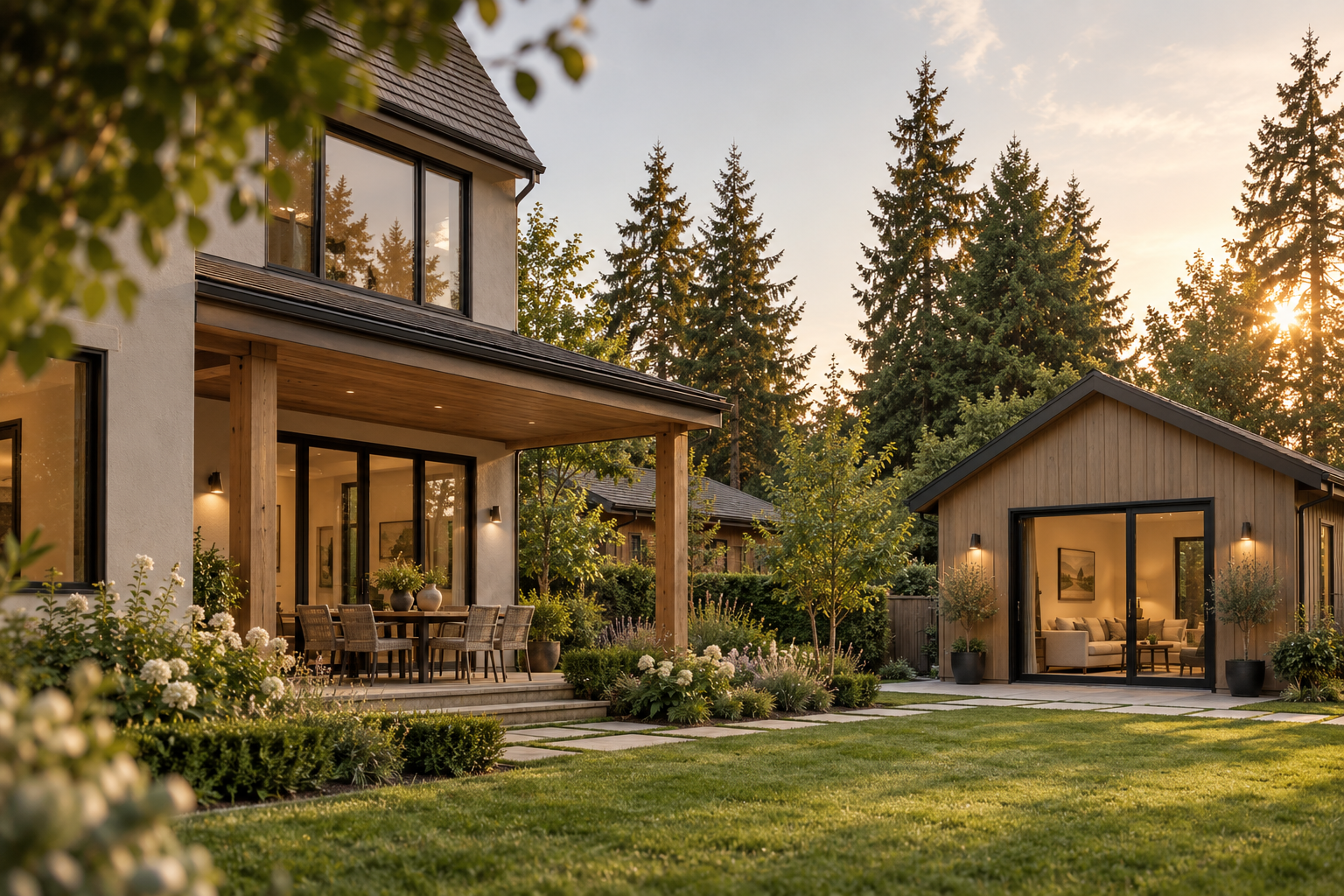
If you're wondering whether you can build a second home, coach house, garden suite, duplex, or multiple homes on your property in Langley, BC, the answer may be yes, and recent changes to housing regulations have created more options for some homeowners.
For families considering multigenerational living, these changes are particularly exciting. Instead of purchasing separate properties, it may be possible to create multiple living spaces on one property, allowing parents, adult children, grandparents, or extended family to live close to one another while maintaining their own privacy and independence.
But how many homes can you actually build?
The answer depends on your property's location, zoning, lot size, municipal servicing, and the type of housing you want to create.
At Homestead Design Build, we help families throughout Langley and the Lower Mainland explore exactly these kinds of projects. Here's what Langley homeowners should know before deciding what's possible on their property.
The Short Answer: How Many Homes Can You Build on One Property in Langley?
Depending on your property, you may be able to create two, three, four or potentially more dwelling units on a single lot.
However, not every Langley property qualifies for the same density.
Under British Columbia's Small-Scale Multi-Unit Housing legislation, municipalities have been required to allow additional housing on many properties that were historically limited to single-family homes.
In the Township of Langley, eligible properties for additional small-scale multi-unit housing generally need to:
be located within the Urban Containment Boundary
be connected to municipal water and sewer
not have a heritage designation by bylaw
not be located within a Transit Oriented Area
be no larger than 4,050 m² (approximately one acre)
not be within a zone that requires a minimum lot size larger than one acre
Properties that don't meet those criteria may still have options. Depending on zoning, the Township states that these properties may instead be eligible for one principal residential unit plus either a secondary suite or an accessory dwelling unit (ADU).
This distinction is especially important in Langley because properties can vary enormously, from smaller suburban lots in areas like Willoughby and Brookswood to larger properties in Murrayville, Salmon River and Campbell Valley.
In other words:
Don't assume your property can (or can't) accommodate another home based on what you've seen elsewhere in Langley.
The first step is understanding the specific rules that apply to your property.
Can I Build a Second House on My Property in Langley?
Potentially, yes.
There are several ways a second living space may be created on a Langley property, depending on the zoning and characteristics of the lot.
That could include:
a detached accessory dwelling unit or garden suite
a secondary suite within an existing home
an addition designed as an independent living space
a duplex or other small-scale multi-unit configuration
a new multigenerational home designed with multiple independent living areas
For families, the more important question is often not simply "Can we build another house?"
It's:
"What's the best way to use this property for our family?"
Those can be two very different questions.
What Changed With BC's Small-Scale Multi-Unit Housing Rules?
British Columbia has introduced significant changes to residential zoning through its Small-Scale Multi-Unit Housing, or SSMUH, legislation.
The goal is to allow more housing types on properties that historically permitted primarily single-family homes.
Depending on the property and applicable regulations, these housing types can include secondary suites, detached accessory dwelling units, duplexes, triplexes and fourplexes.
Provincial regulations require applicable local governments to permit a minimum of three units on certain lots of 280 m² or less and four units on certain lots larger than 280 m². Provincial rules also establish higher minimum density requirements in some areas near qualifying frequent transit.
That does not mean every property in Langley automatically qualifies for three, four or more homes.
Local conditions and exemptions still matter, and the Township of Langley has specific eligibility requirements.
That's why property-specific due diligence is so important before you start designing.
What If I Have a Large Property or Acreage in Langley?
This is where things become particularly interesting — and also more property-specific.
Many families looking at multigenerational living already own larger properties in areas such as South Langley, Campbell Valley, Salmon River, Brookswood, Murrayville and Fort Langley.
A large lot doesn't automatically mean you can build more homes.
In fact, some of the provincial small-scale multi-unit housing requirements are specifically focused on smaller urban lots connected to municipal infrastructure.
Larger and rural properties can be subject to different zoning, servicing and land-use requirements.
But that doesn't mean multigenerational living isn't possible.
Depending on the property, options may include a secondary suite, accessory dwelling unit, addition, replacement home designed for multiple generations, or another configuration permitted under the property's zoning.
This is why we encourage families to look beyond simply asking:
"How many houses am I allowed to build?"
Instead, start with:
"We want these family members to live on this property. What are our options?"
From there, the property can be assessed and the best route explored.
What If My Property Is on Well and Septic?
This is an important consideration in Langley.
Many larger properties throughout South Langley and surrounding communities rely on private wells and septic systems rather than municipal water and sewer.
That can affect what's possible.
Adding another dwelling can increase water demand and wastewater requirements. Existing septic systems may need to be assessed, upgraded, expanded or replaced, and the property needs sufficient space for an appropriate system.
Water supply and treatment may also need to be considered.
We've built our own home on well and septic and have worked on numerous properties where these systems are a significant part of the planning and construction process.
For families considering multiple generations on a rural property, we prefer to look at these issues early, before significant money is invested into a design that may not work with the property's servicing constraints.
Can I Build a House for My Parents in My Backyard?
This is one of the most common questions families ask us.
And depending on your property, a detached home isn't the only option.
Imagine, for example, that you're trying to create a home for aging parents.
You could potentially explore:
A detached garden suite or ADU
This can provide the greatest physical separation while still keeping family only steps away.
An attached addition
A thoughtfully designed addition can provide a private entrance, kitchen, living room, bedroom, bathroom and outdoor area while keeping both households connected.
A secondary suite
For some properties, converting or expanding an existing home may be significantly more practical than constructing another building.
A purpose-built multigenerational home
If the existing home no longer works for the family, rebuilding can create something entirely different: one home designed from the beginning to accommodate two or more generations.
There isn't one "best" multigenerational layout.
The right solution depends on the family, the property and how you actually want to live together.
What About Building a Home for Adult Children?
Multigenerational living isn't only about aging parents.
We're increasingly having conversations with families asking how they can help their adult children establish a home in the Lower Mainland.
Instead of asking:
"How can our kids ever afford a house here?"
another question is:
"Could we use the property or equity our family already has differently?"
For some families, creating another dwelling or designing a property for multiple households could provide an alternative to purchasing two completely separate properties.
It may allow generations to pool resources while still creating distinct homes and maintaining independence.
There are significant financial, legal, mortgage and estate-planning considerations involved in arrangements like these, so families should involve the appropriate financial and legal professionals.
But from a building and design perspective, the possibilities are worth exploring.
Can We Build One House That Feels Like Two Separate Homes?
Absolutely — and for many multigenerational families, this can be a better solution than simply adding a conventional basement suite.
A multigenerational home can be intentionally designed around privacy and independence.
That could mean:
separate entrances
separate kitchens
separate laundry
independent living rooms
bedrooms located away from shared walls
sound separation between living spaces
separate outdoor areas
accessible bathrooms
wider hallways and doorways
main-floor living for aging parents
shared spaces that connect the households when desired
The goal doesn't have to be to make everyone share everything.
In fact, we often believe successful multigenerational homes should allow family members to choose when they're together.
You can be close enough for grandparents to have dinner with their grandchildren, help with childcare, or receive support as they age — without feeling like everyone is living in the same household.
Should We Renovate, Add On, or Build New?
This is another question that doesn't have a universal answer.
Renovating may make sense when:
The existing home's footprint and structure already provide enough space and the property works well for the family.
An addition may make sense when:
You love the existing home and property but need another independent living area.
A detached dwelling may make sense when:
The property permits it and privacy between households is a major priority.
Building new may make sense when:
The existing home would require extensive compromises or renovations to accommodate the family's long-term needs.
Sometimes families come to us convinced they need a second detached home when an addition would accomplish their goals more effectively.
Other times, they begin by considering a renovation and realize a purpose-built multigenerational home would make much better use of the property.
The property should help determine the design — not the other way around.
What Should I Find Out Before Designing Multiple Homes on My Property?
Before spending significant money on architectural plans, we recommend understanding several things about the property:
1. Zoning
What uses and dwelling configurations are permitted?
2. Lot size and location
Is the property subject to Langley's small-scale multi-unit housing regulations, or another set of zoning requirements?
3. Water and sewer
Is the property municipally serviced or on private well and septic?
4. Site constraints
Consider setbacks, access, existing structures, trees, slopes, easements, rights-of-way and other site conditions.
5. The family's long-term plan
Who will live there now?
Who might live there 10 or 20 years from now?
Could an aging parent eventually need accessible living?
Could today's space for a parent eventually become a home for an adult child?
Could the property need to adapt again as the family changes?
These questions matter because the best multigenerational homes aren't designed only for the family's current situation.
They're designed to evolve.
How Do I Find Out What I Can Build on My Langley Property?
Start with the property itself.
Rather than choosing a floor plan or deciding you want a coach house immediately, determine what's possible under the property's zoning, servicing and site constraints.
From there, you can compare the realistic options.
For example:
Existing home + secondary suite
vs.
Existing home + detached dwelling
vs.
Renovation + addition
vs.
Demolish and build a purpose-designed multigenerational home
The "best" option isn't necessarily the one that creates the greatest number of units.
It's the one that makes the best use of your property, budget and family's long-term needs.
Building a Multigenerational Home in Langley or the Lower Mainland?
At Homestead Design Build, multigenerational living isn't simply a construction niche we're interested in.
It's how our own family lives.
We understand the appeal of having generations close together — and we also understand why thoughtful design, privacy and independence matter so much when multiple generations share a property.
As a licensed residential builder based in Langley, we help families explore custom homes, major renovations, additions and multigenerational living solutions throughout Langley and the Lower Mainland.
Our role isn't simply to build what you ask for.
We can help you look at the property, understand your family's goals, coordinate the professionals required for the project, navigate design and permitting, and determine a practical path from "Could we do this?" to a home your family can use for generations.
Wondering What You Could Build on Your Property?
You don't need to know whether you need a coach house, addition, suite or completely new home before reaching out.
Start with your property and your family.
Tell us where the property is located, who you're hoping to create a home for, and what you'd ideally like your living arrangement to look like.
From there, we can start exploring what's possible.
Have a property in Langley or the Lower Mainland you're considering for multigenerational living? Contact Homestead Design Build to start the conversation.
Your home for generations.
multiple homes on one property Langley BC, build second house on property Langley, two houses on one lot Langley BC, garden suite Langley BC, coach house Langley BC, ADU Langley BC, multigenerational homes Langley BC, multigenerational home builder Langley, acreage builder Langley BC, secondary dwelling Langley BC, Bill 44 Langley BC, fourplex Langley BC
“Can I build another house on my property in Langley?”, “Can I build a house for my parents in my backyard?”, “How many houses can you have on one lot in BC?”, “Can I build multiple houses on acreage in Langley?”, “Can my adult children build a house on my property?”, “Can I have a main house and a coach house in Langley?”, “What can I build on my property in Langley BC?”